



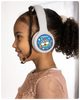
What Should Parents Look for When Choosing Kids Headphones?
, by Shyam Raj, 16 min reading time
, by Shyam Raj, 16 min reading time
Choosing the right headphones for toddlers requires careful attention to safety, comfort, fit, and durability. In this guide, discover what parents should look for when buying headphones for toddlers, including reliable volume limits, child-sized designs, and wired or wireless connectivity. Learn when noise cancellation may be useful for travel and how listening habits affect hearing safety. Explore BuddyPhones features, including SafeAudio® volume-limiting technology, comfortable designs, and models suited to home, school, and travel. Whether your child listens to stories, enjoys educational content, or travels with family, find practical tips to help you choose suitable kids’ headphones.
Choosing headphones for a child often starts with a simple question: which pair will actually work for them?
The answer depends on several factors, including the child’s age, how and where the headphones will be used, and what they will be listening to. A child using headphones during a school activity has different needs from a toddler listening to a story at home. A family that travels regularly may also have different priorities.
Whether your child uses headphones for school, travel, games, audiobooks, or screen-free entertainment, the right pair should do more than simply play sound. Parents should look for kids headphones that combine hearing protection, comfort, durability, and easy everyday use.
Here are the most important factors to consider before buying.
If headphones are mainly used at home, a simple and comfortable pair may be enough. If your child travels to school every day, parents may need to think about durability and how easily the child can connect the headphones to a computer or tablet.
Look for headphones that:
Are versatile enough for both learning and travel, eliminating the need to purchase a separate pair for different activities.
Offer the flexibility to switch easily between home use, schoolwork, and on-the-go entertainment.
Match your child’s age, listening habits, and preferred devices.
For example, headphones for toddlers should usually be lightweight, simple to use, and fitted with a dependable volume limit. Older children may need headphones for online classes, gaming, travel, or shared devices.
The most important feature in children’s headphones is a built-in volume limiter. Children may turn up the volume to block outside noise or hear audio more clearly, so a dependable limit can help prevent unnecessarily loud listening.
Many parents look for kids’ headphones with a volume limit of 85 dB or lower. However, volume safety also depends on how long and how often a child listens. The World Health Organization advises keeping headphone music exposure low, limiting exposure at 85 dBA to shorter periods, and listening at no more than 60% of a device’s maximum volume.cdn.
When shopping, look for:
A clearly stated maximum volume level, ideally 85 dB or lower.
Parental volume controls, if available.
A design that maintains the limit in both wired and wireless modes.
Clear information about how the volume limit works.
Parents should also remember that volume limiting is only one part of safe listening. Listening time, background noise, and regular breaks also matter. The American Academy of Pediatrics recommends that children should be able to hear when spoken to while using a personal listening device and should take listening breaks.
Adult headphones are often too large and heavy for children. A poor fit can cause pressure around the ears, make the headband slip, or encourage children to increase the volume because outside noise is still audible.
Age matters too. A pair that fits an older child may feel too large on a younger one. When headphones do not fit properly, children may keep adjusting them or take them off altogether. Therefore, it is essential to choose comfortable kids’ headphones that work for your child.
Choose a pair with:
An adjustable headband that comfortably fits now and grows with your child.
Small, soft ear cushions that fully surround or comfortably rest over the ears.
A lightweight design that does not feel tiring after 20–30 minutes.
Smooth edges and flexible materials.
Padding that does not become hot or uncomfortable quickly.
A secure fit that stays in place during travel or movement.
The headphones should feel snug but not tight. If your child frequently removes them, complains about pressure, or develops red marks around the ears, the fit may not be suitable.
Children’s headphones are likely to be dropped, bent, pulled, stuffed into bags, and occasionally exposed to food or drinks. A fragile pair may not last long, even if the sound quality is excellent.
Look for durable kids’ headphones with:
A flexible headband that can withstand bending and breakage from rough use.
Reinforced hinges and cable connection points.
Durable ear cushions that can be wiped clean.
Strong buttons that are easy to press.
Tangle-resistant or reinforced cables.
Some level of spill or sweat resistance for travel and everyday use.
A foldable design can be convenient for school bags and airplane travel, but check that the folding hinges feel secure. More moving parts can create additional points of failure if the construction is weak.
The best choice depends on how your child will use the headphones.
|
Feature |
Wired headphones |
Wireless headphones |
|
Battery |
No charging required |
Requires regular charging |
|
Compatibility |
Simple for airplanes, tablets, and laptops with a headphone jack |
Convenient for phones, tablets, and newer devices |
|
Cost |
Often more affordable |
Usually costs more |
|
Travel |
Useful with in-flight entertainment systems |
May require Bluetooth pairing, an external cable for wired use |
|
Safety considerations |
Check cable length and connection strength |
Check whether volume limiting remains active in Bluetooth mode |
|
Sharing |
Often supports audio-sharing cables |
May support multiple-device features depending on the model |
For frequent travel, wired compatibility can be especially useful. For everyday use at home, wireless kids’ headphones may be more convenient because there is no cable to catch on furniture or clothing.
If choosing wireless headphones, confirm:
The battery lasts long enough for a typical day or journey.
Charging is simple.
The headphones automatically reconnect easily.
The volume limit cannot be bypassed when used wirelessly.
The controls are simple enough for your child.
Some children may benefit from having both options. A model that works wirelessly and includes a wired backup connection can be useful for home, school, and travel.
Noise cancellation makes the most sense when a child regularly listens in a noisy environment.
A child travelling on an aeroplane, sitting in a busy airport, or trying to listen during a noisy journey may find background noise distracting. In those situations, noise cancelling headphones for kids can help reduce some surrounding sound and make listening easier.
At home, the situation may be completely different. If a child normally listens in a quiet bedroom, noise cancellation may not be a priority. It is a feature that should match the environment rather than something parents need to choose simply because it sounds impressive.
Active noise cancellation, or ANC, reduces certain background sounds electronically. Passive noise isolation comes from the physical seal created by the ear cushions. ANC can make it easier for children to hear content clearly without raising the volume, but it does not replace volume limiting or safe listening habits.howtogeek
Parents should also understand what noise cancellation can and cannot do. It is designed to reduce certain types of surrounding sound; it does not make every outside noise disappear.
That distinction is useful when deciding whether the feature is actually relevant to a child’s routine.
If choosing kids’ noise cancelling headphones, look for:
Active noise cancellation that works in the listening mode your child will use.
A dependable volume limit that remains active when ANC is switched on.
A comfortable over-ear fit that also provides passive noise isolation.
A transparency or awareness mode, if your child needs to hear surrounding sounds.
A battery that lasts for the full journey.
A wired backup connection for airplanes or when the battery is empty.
Simple controls that a child can understand.
BuddyPhones is one option worth considering if parents want volume-limited children’s headphones with different wired, wireless, learning, and travel-focused models.
BuddyPhones are designed to address several of the features parents should prioritize in kids’ headphones. Their SafeAudio® technology limits volume, while adjustable headbands and cushioned ear pads help provide a child-friendly fit. Depending on the model, parents can choose wired headphones for simplicity, wireless headphones for everyday convenience, or active noise cancellation for travel.
All BuddyPhones models include SafeAudio® volume-limiting technology, whether they are wired or wireless.
BuddyPhones wired models provide a single 85 dB volume limit, while BuddyPhones wireless models offer three SafeAudio® settings: 75 dB, 85 dB, and 94 dB.
For everyday listening at home, at school, or while travelling, the 75 dB or 85 dB setting is the most suitable choice. The 94 dB setting is best reserved for occasional use in very noisy environments, such as during a flight.
Even with volume limiting, healthy listening habits still matter. The WHO notes that safe listening depends not only on volume, but also on how long and how often a child listens. Encourage your child to take regular breaks and remove their headphones when someone needs to speak to them.
BuddyPhones are made specifically for children, with adjustable headbands, cushioned ear pads, and designs intended to withstand everyday handling. Their kid-focused construction makes them suitable for use at home, school, and while traveling.
Parents should still check the fit against their child’s head size. A comfortable pair should feel secure without causing pressure or leaving red marks around the ears.
Different BuddyPhones models support different connection types:
Wired models are simple, do not require charging, and work well with tablets, computers, and airplane entertainment systems.
Wireless models provide Bluetooth convenience for daily use.
Some models can be used both wirelessly and with a cable, providing a backup option when the battery is empty.
This flexibility makes it easier for parents to choose a model based on the child’s routine rather than choosing between safety and convenience.
Selected BuddyPhones models include StudyMode®, which is designed to make voices clearer for online lessons, audiobooks, and educational content. Some models also include a built-in microphone or detachable boom microphone for schoolwork, calls, and video chats.
Other practical features may include foldable designs, audio sharing through BuddyJack® or BuddyLink, and active noise cancellation on selected models. These features can be useful for families with multiple children or for children who regularly listen during travel.
The most suitable model depends on the child’s age, daily routine, and whether wireless features are important.
|
Use case |
Suitable BuddyPhones direction |
Benefits |
|
Basic home use or younger children |
Simple connection, 85 dB volume limit, detachable cable, microphone, and audio sharing on compatible versions. |
|
|
Everyday wireless listening |
Bluetooth connectivity, listening modes, built-in microphone, and a backup wired connection. |
|
|
Airplanes and busy environments |
Active noise cancellation that works in both wireless and wired modes, 3 selectable volume-limiting settings, and travel-friendly features make this model a practical choice for busy journeys. |
|
|
Online classes and calls |
Includes StudyMode® - Voice-enhancing audio and a detachable boom microphone can make speech clearer during lessons. |
|
|
Families with multiple children |
Any BuddyPhones models & and BuddyCable |
Allows up to 4 BuddyPhones to share audio from one device. |
Explore BuddyPhones’ volume-limited kids’ headphones to find a model suited to your child’s home, school, and travel needs.
Many parents choose kids’ headphones with an 85 dB maximum volume. Some models also offer a lower 75 dB setting for quieter environments. However, safe listening also depends on how long and how often a child listens, so regular breaks are important.
Wireless kids’ headphones can be safe if they include dependable volume limiting and the limit remains active in Bluetooth mode. Parents should also check battery life, charging requirements, and whether the headphones include a wired backup option.
Noise cancelling headphones for kids are most useful for travel, airplanes, trains, and other noisy environments. They can help children hear audio clearly without increasing the volume, but they are not necessary for every child.
BuddyPhones are designed for children and include SafeAudio® volume-limiting technology. Depending on the model, they offer either an 85 dB maximum volume or selectable 75 dB, 85 dB, and 94 dB settings. Parents should use the lower settings for regular listening and reserve higher settings for occasional noisy environments.
Before buying, ask:
Does the product have a clearly explained volume limit?
Is the limit active in every listening mode?
Are the headphones light and comfortable enough for my child?
Can the headband adjust as my child grows?
Will they survive drops and everyday handling?
Are the controls simple?
Will they work with our tablet, phone, computer, or airplane system?
Does the battery last long enough if wireless?
Can my child still hear me when I speak?
Is there a warranty or return option?
The best kids’ headphones balance hearing protection, comfort, durability, sound clarity, and ease of use. BuddyPhones are a practical option for parents who want built-in volume protection alongside child-friendly designs and features for home, school, and travel.
Start with a dependable volume limit and a comfortable fit, then choose the BuddyPhones model based on your child’s needs. Wired models suit families looking for simplicity, wireless models offer everyday convenience, and travel-focused models can add active noise cancellation and selectable listening modes.
Most importantly, teach children to keep the volume comfortable, take regular breaks, and remove their headphones when someone needs to speak to them. Even the safest headphones work best when combined with healthy listening habits.


